


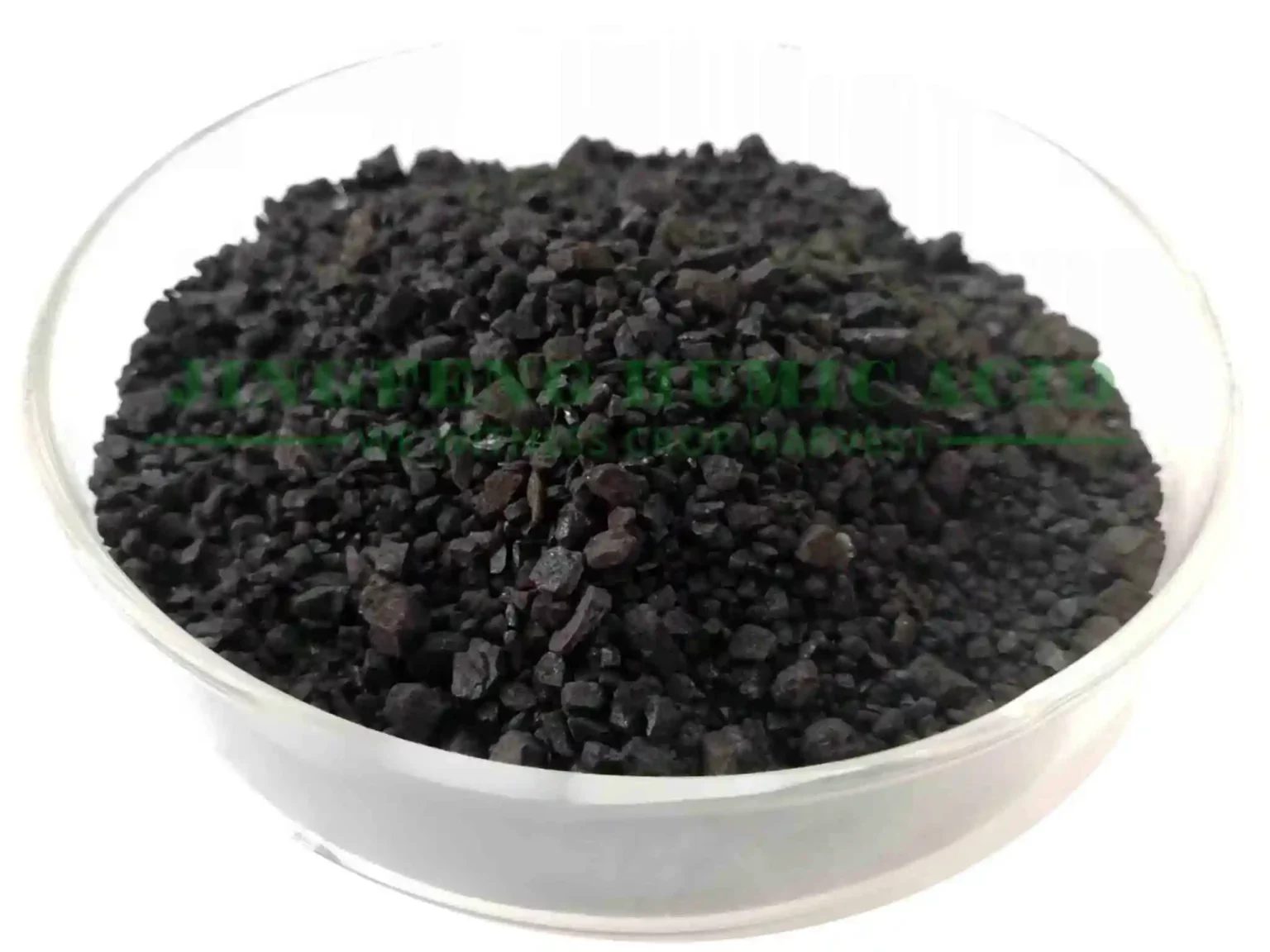
Super Potassium Humate Flakes / Powder Overview
ISO, CERES EU/NOP & EU REACH-compliant Potassium Humate (65-70% Humic Acid) features large molecular weight for superior water-locking (ideal for sandy/heavy clay soils).
Fully water-soluble, it activates beneficial soil microbes, boosts root vigor and cation exchange capacity, and enhances drought/salinity/cold/heat resistance.
Designed for standalone application (not compatible with fertilizers/pesticides), it’s perfect for organic farming, hydroponics, seed treatment, orchards and high-performance sustainable agriculture.
* Note: Need a potassium humate compatible with fertilizers/pesticides? See our complementary product – Mineral source humic fulvic fertilizer (formulated for standard agri-input compatibility).
Super Potassium Humate Flakes / Powder Technical Details
| Appearance | Black Flakes / Powder |
| Product code | JFHA-KHA-1-F/P |
| Water Solubility | 100% |
| Potassium(K₂O dry basis) | 10.0%-12.0% min |
| Humic Acid(dry basis)* 1/2 | 65.0-70.0% min |
| Fulvic Acid(dry basis)* 1 | 2.0% min |
| Moisture | 15.0% max |
| Particle size | 1-2 mm |
| Fineness | 80-100 mesh |
| pH | 9-10 |
* 1 is the test methods,HGT5334-2018 / ISO 19822 / HPTA / AAPFCO / IHSS Analysis method
* 2 is another test method, CDFA / Colorimetric method
Recommended Applications
Application Scope
Agricultural Crops
Field crops such as wheat, corn, rice, cotton, and oilseeds, soybeans, sugar beet, barley, and so on.
Vegetables
Open-field and greenhouse vegetables including tomatoes, cucumbers, peppers, lettuce, and broccoli.
Fruit Trees
Pome fruits (apple, pear), stone fruits (peach, cherry), citrus, grapes, and berries, Tropical & Subtropical Fruits.
* Other Scenarios: Hydroponics, substrate cultivation, lawn & landscape greening, seed treatment, nursery production, and flower farming.
Application Methods
| Application Method | Key Operations | Suitable Scenarios | Advantages |
|---|---|---|---|
| Soil Incorporation (Base Fertilizer) | Spread uniformly, plow 10-20 cm deep to mix with soil. | Field crops, fruit trees, vegetables (pre-sowing/transplanting) | Long-term soil improvement, enhances water/nutrient retention (leveraging large molecular weight advantage) |
| Ditching/Hole Topdressing | Dig trenches/holes near root zones (avoid direct root contact), apply and cover soil. | Fruit trees, cash crops (growth stage) | Reduces nutrient loss, targets root absorption |
| Drip Irrigation/Drenching | Dissolve in water (follow dilution ratio), apply via drip system or root drenching. | Greenhouses, water-saving agriculture, saline-alkaline/sandy soils | Fast absorption, improves water-use efficiency |
| Foliar Spraying | Prepare dilute solution, spray evenly on leaf surfaces (focus on young foliage). | Critical stages (blooming, fruit enlargement, stress periods) | Rapid stress relief, boosts photosynthesis |
| Seed Treatment (Soaking/Coating) | Soak seeds in 0.1-0.5% solution for 6-12 hours, or coat with powder. | All crops (seedling stage) | Improves germination rate, strengthens seedling vigor |
Recommended Dosage by Crop Type
| Crop/Scenario | Soil Type | Dosage (Acre/Ha) | Application Timing |
|---|---|---|---|
| Wheat/Corn/Rice (Base) | Loam/Sandy Loam | 15-25 kg / 37.5-62.5 kg | Pre-sowing/transplanting |
| Wheat/Corn/Rice (Base) | Saline-Alkaline/Sandy | 25-30 kg / 62.5-75 kg | +25% dosage for water-locking |
| Cotton/Soybean (Topdress) | Arid/Semi-Arid | 1.0-1.5 kg / 2.5-3.75 kg | Blooming-podding stage (1-2x) |
| Fruits (Apple/Grape) | All Soils | 30-40 kg/acre (base); 1.0-1.2 kg/ha (topdress) | Dormant period; fruit enlargement |
| Vegetables (Tomato/Potato) | Greenhouse/Field | 15-20 kg/acre (base); 0.2-1.0 kg/acre (topdress) | Transplanting; fruiting/tuber initiation |
| Organic Farming | All Soils | 25-40 kg/acre (base); 1.0-1.5 kg/acre (topdress) | Comply with CERES EU/NOP standards |
| Drought/Saline-Alkaline | Degraded Soils | +20-30% vs. standard | Split application (autumn + spring) |
Mixing Steps
- Half-filled water
- Add liquid humic acid
- Add other fertilizers/pesticides
- Fill water and stir

COMPATIBILITY TEST REQUIRED BEFORE BLENDING
- Conduct small-scale trial at actual dilution ratio.
- Stand 10-15 mins; check for flocculation/precipitation.
- Blend in full scale only if no anomalies—avoid operational issues.
STIR CAUTION
Blend → stir → stand 30 mins → stir again.
Avoid stratification & reduced efficacy.
Packaging & Storage
We offer a range of standard packaging solutions: 1kg, 5kg, 10kg, 20kg, 25kg bags,and 1ton jumbo bags..Custom packaging services are also available. Our team will provide tailored recommendations based on your specific requirements to ensure proper storage and transportation, maintaining product integrity throughout the process.
1kg bag
10kg 20kg 25kg bag
jumbo ton bag
Certifications & Compliance
- CERES (Confirmationfor Materials Used in Organic Agriculture)
- REACH (Green chemical innovation, permitted in the EU)
- ISO9001 / ISO14001 / ISO22000
- Heavy Metal Test Report from ISO certified lab
Safety Data Sheet / Technical Data Sheet
- MSDS (Super Potassium Humate Flakes / Powder material safety data sheet)
- TDS (Super Potassium Humate Flakes / Powder material safety data sheet)
Successful Cases
- Application Details: Foliar spray + drip irrigation with Super Potassium Humate during the whole growth period .
- Key Results: Yield increased by 35%, soluble sugar content by 30%, and sugar-acid ratio by 41%. Root length increased by 118% at the seedling stage, and phosphorus absorption in fruits increased by 45%.
- Core Value: Enhanced nutrient uptake efficiency in sandy soil, leveraging the product’s water-retention and chelation properties.
- Source: Chinese Society of Agricultural Science Journals
- Application Details: 6% potassium humate foliar spray combined with 100 mg/L proline during the growth period .
- Key Results: Significantly reduced salt stress damage, increased grain protein content, and achieved the highest yield among all treatments.
- Core Value: Enhanced crop salt tolerance, verifying the product’s effectiveness in degraded soil remediation.
- Source: Journal of Soil Sciences and Agricultural Engineering
- Location: Gaotang County, Liaocheng City, Shandong Province (concentrated saline-alkaline soil area)
- Crop: Winter Wheat
- Application Scheme: Apply high-purity potassium humate (65-70% humic acid) as base fertilizer, supplemented with the same type of product for topdressing. Uniformly spread before sowing, plow 15-20 cm deep for soil mixing; apply via drip irrigation during the wheat regreening stage for topdressing.
- Core Results: Broke the “low-yield curse” of saline-alkaline soil—wheat yield reached 746 kg per mu (≈11.2 tons/ha), an increase of 100 kg per mu compared to traditional fertilization. The wheat growth cycle returned to normal, with robust plants and plump ears, effectively alleviating the “early maturity and low yield” caused by saline-alkaline stress.
- Core Value: Leveraging the acid-adjusting and alkali-inhibiting properties of high humic acid content, it improves soil structure, enhances water and nutrient retention capacity, and strengthens wheat stress resistance—achieving a win-win for saline-alkaline soil remediation and high crop yield.
- Source: Field Report by Sohu.com
- Location: Yanzike Ecological Tea Garden, Wuyishan City, Fujian Province (sandy loam soil with low organic matter and poor water/nutrient retention)
- Crop: Wuyi Rock Tea
- Application Scheme: Apply 25-30 kg per mu of high-purity potassium humate mixed with organic materials as base fertilizer, plow deeply for uniform mixing; conduct drip irrigation topdressing every 2 months during the growing period, 1.0-1.2 kg per mu each time.
- Core Results: Soil compaction was significantly improved, soil looseness increased, and the number of tea tree capillary roots increased by over 40%. Tea quality was greatly enhanced—amino acid content increased by more than 30%, tea polyphenols by 20%, resulting in rich aroma and mellow taste, meeting organic tea standards.
- Core Value: Utilizes the advantage of large-molecular-weight potassium humate in constructing soil aggregate structure, improves water and nutrient retention of sandy loam soil, and activates beneficial soil microorganisms—providing a healthy soil environment for organic tea cultivation.
- Source: Report by NetEase News “China Tour of Agricultural University Humic Acid Quality”, Supporting Research on Tea Quality by Chengdu Institute of Biology, Chinese Academy of Sciences
- Location: Protected Agriculture Park, Xinxiang City, Henan Province (continuous cropping greenhouse plots)
- Crop: Pepper
- Application Scheme: Foliar spraying during the growing period—dilute high-purity potassium humate 10,000 times with water, spray evenly on both sides of leaves, once every 15 days for 3 consecutive applications.
- Core Results: Pepper plants grew robustly, plant height increased by 12-15%, and fruit setting rate by 18%. Soluble sugar content of fruits increased significantly, nitrate content decreased by over 35% with better quality; meanwhile, pepper resistance to diseases under high humidity in greenhouses was enhanced.
- Core Value: Relies on the biostimulant effect of high-activity humic acid to activate the pepper’s own enzyme system, promote nutrient absorption, and reduce pollutant accumulation—adapting to the needs of green production of protected vegetables.
- Source: Research Paper on China Humic Acid Network
- Location: Lakeside of Central Yunnan, Yuxi City, Yunnan Province (sandy soil with weak water and nutrient retention capacity)
- Crop: Protected Tomato
- Application Scheme: Apply 30 kg per mu of high-purity potassium humate as base fertilizer, mixed with a small amount of organic fertilizer and plowed 20 cm deep; adopt a combined method of “drip irrigation topdressing + foliar spraying” during the growing period—1.0 kg per mu each time via drip irrigation, once every 10 days; spray 800-fold diluted solution twice during the fruit enlargement stage.
- Core Results: Soil water retention capacity of sandy soil increased by 70%, effectively alleviating the problem of “water and nutrient leakage”. Tomato roots developed, root length increased by 118%, and yield increased by 35%. Soluble sugar content of fruits increased by 30%, sugar-acid ratio optimized by 41%, with significantly improved taste and marketability.
- Core Value: Highlights the super water-locking advantage of large-molecular-weight potassium humate, specifically addressing the pain points of sandy soil, while enhancing tomato resistance to drought and nutrient loss—realizing high-yield and high-quality cultivation in sandy soil.
- Source: Agricultural Technology Practice Sharing on Douyin Platform
Super Potassium Humate Flakes / Powder FAQ
- It promotes beneficial soil microbial activity and improves soil structure over time, without causing compaction or nutrient imbalance.
- Avoid excessive application—overdosing may lead to overly vigorous root growth but slower above-ground plant development.
- For saline-alkaline or heavy-metal contaminated soils, combine with soil testing and apply in split doses to prevent potential heavy-metal accumulation.
- Follow recommended dosage ranges (base + topdressing) for sustained soil and crop health.
- Flakes: Slower dissolution (10-15 mins stirring or overnight soaking for large-scale use), cost-effective, suitable for base application/soil incorporation.
- Powder: Instant dissolution (5 mins), convenient for drip irrigation/foliar spraying. Choose based on application method: flakes for base fertilization; powder for topdressing (drip/foliar) or time-sensitive scenarios.
- Saline-alkaline soil: Increase dosage by 20-30% (base + topdressing) to enhance acid-adjusting and alkali-inhibiting effects;
- Sandy soil: Increase by 15-25% to maximize water-locking capacity;
- Clay soil: Reduce by 10-15% (avoids excessive moisture retention);
- Fertile soil: Reduce by 10-20% to prevent nutrient leaching.
- Soil improvement effects (loosening, water retention): Visible in 2-4 weeks (e.g., saline-alkaline soil EC value decreases by 15-20%);
- Crop growth effects (root development, vigor): 1-2 weeks for foliar spray/drip irrigation;
- Yield and quality improvement: Manifested in critical stages (flowering, fruit enlargement) or at harvest (yield +11.5-35%, sugar content +7-30%).
- CERES EU/NOP (organic input certification);
- ISO Quality Management System Certification;
- EU REACH Compliance. It can be directly used in organic crop cultivation without violating certification requirements.
- Foliar spraying: Dilute 1:500-800 (w/v) with clean water (pH 6.0-7.5), spray on both leaf sides in early morning or late afternoon (avoid direct sunlight);
- Drip irrigation: Dilute 1:200-300 (w/v), stir thoroughly until fully dissolved, filter with 120-150 mesh screen to prevent nozzle clogging;
- Key note: Flakes need pre-soaking (10-15 mins) before dilution.
- Higher humic acid content (65-70% vs. 50-60% for ordinary products);
- Large molecular weight (2-3x stronger water-locking and soil improvement effects);
- Strict organic certifications (CERES EU/NOP, REACH) for global market access;
- Proven results (11.5-35% yield increase in domestic field trials, applicable to problematic soils like saline-alkaline/sandy soil).
- Avoid direct contact with crop roots (dig trenches/holes 15-20 cm away during topdressing) to prevent root burn;
- Wear gloves and a mask when operating, rinse with water immediately if it comes into contact with skin/eyes;
- Keep away from children and pets;
- Do not mix with strong acidic/alkaline substances (e.g., concentrated sulfuric acid-based fertilizers) to avoid flocculation.
Related Products




Insoluble Humic Acid Product Overview
Insoluble Humic acid is formed by microbial degradation of the dead biological substances. Its specific properties and structure depending on a given sample source from water or soil to extract the specific conditions.Products we have are humic acid powder, granular humic acid and humic acid crystal.
Humus in soils and sediments can be divided into three main parts: humic acid (HA), fulvic acid (FA) and humin (HM). HA is soluble in alkali solution, but not soluble in water and acid, FA is soluble in alkali, soluble in water and acid; the HM is neither soluble in alkali, nor soluble in water and acids.
Insoluble Humic Acid Technical Details
| Appearance | Black Powder / Granule / Crystal | |
| Product code | JFHA-HA-1-P/G/C | JFHA-HA-2-P/G/C |
| Organic Matter (dry basis) | 85.0% min | 80.0% min |
| C.E.C | ≥250meq / 100g | ≥200meq / 100g |
| Free Humic Acid (dry basis) 1 | 60.0% min | 50.0% min |
| Moisture | 25.0% max | |
| Particle size | 2-4mm / 2-6mm | |
| Fineness | 80-100 mesh | |
| Granule Radial Load | 12N | |
| pH | 4-6 | |
* 1 Test Methods,GB/T 11957-2001 / ISO 19822 / HPTA / AAPFCO / IHSS Analysis method
Recommended Applications for Insoluble Humic Acid
Application Scope
Agricultural Crops
Field crops such as wheat, corn, rice, cotton, and oilseeds, soybeans, sugar beet, barley, and so on.
Vegetables
Open-field and greenhouse vegetables including tomatoes, cucumbers, peppers, lettuce, and broccoli.
Fruit Trees
Pome fruits (apple, pear), stone fruits (peach, cherry), citrus, grapes, and berries, Tropical & Subtropical Fruits.
* Other Scenarios: substrate cultivation, lawn & landscape greening, nursery production, and flower farming.
I. Core Application Scenarios & Dosage
1. Soil Improvement (Primary)
Soil Type | Powder Dosage (kg/hectare) | Granule Dosage (kg/hectare) | Frequency |
|---|---|---|---|
Sandy/Barren | 750-1,200 | 1,200-1,800 | 1-2 times/year (Spring/Autumn) |
Heavy Clay/Saline-Alkaline | 1,200-1,800 | 1,800-2,250 | 2 times/year (Deep + Shallow plowing) |
Ordinary Farmland/Orchard | 450-750 | 750-1,200 | 1 time/year (Base fertilizer) |
2. Crop Base Fertilizer
3. Targeted Scenarios
- Seedling substrate: Add 5%-10% (volume) powder to improve germination rate and seedling vigor.
- Saline-alkaline/degraded soil: 1,800-2,250kg/hectare granules + 750kg/hectare gypsum (saline-alkaline); 2,250-3,000kg/hectare (mine reclamation/wasteland).
II. Powder vs. Granules Selection
Feature | Powder | Granules | Recommended Clients |
|---|---|---|---|
Convenience | Needs mixing; high uniform requirement | Direct application; mechanized-friendly | Smallholders (powder); large mechanized farms (granules) |
Efficacy/Validity | Faster onset (1-2 weeks) | Longer validity (3-6 months) | Short-cycle crops (powder); long-cycle crops (granules) |
Transport/Storage | Dusty; moisture-proof packaging needed | Dust-free; low loss | Domestic short-distance (either); international trade (granules) |
Cost | Lower unit price | Higher cost but labor-saving | Cost-sensitive (powder); efficiency-focused (granules) |
III. Key Usage Notes
- No foliar spray (insoluble, causes leaf burn/clogged sprayers; soil application only).
- Irrigate after application to avoid soil compaction.
- Not a fertilizer substitute; use with NPK/compound/organic fertilizers.
- Suitable for pH 5.5-8.5; adjust acidic soil (pH<5.5) with lime first.
- Seal and keep moisture-proof; avoid mixing with acids; crush clumped granules for reuse.
Packaging & Storage
We offer a range of standard packaging solutions: 20kg, 25kg bags,and 1ton jumbo bags.Custom packaging services are also available. Our team will provide tailored recommendations based on your specific requirements to ensure proper storage and transportation, maintaining product integrity throughout the process.
20kg 25kg bag
Jumbo ton bag
Certifications & Compliance
- CERES (Confirmationfor Materials Used in Organic Agriculture)
- REACH (Green chemical innovation, permitted in the EU)
- ISO9001 / ISO14001 / ISO22000
- Heavy Metal Test Report from ISO certified lab
Safety Data Sheet / Technical Data Sheet
- MSDS (Insoluble humic acid material safety data sheet)
- TDS (Insoluble humic acid material safety data sheet)
Successful Cases
1. Core Successful Cases
Case 1: Saline-Alkali Soil Remediation (Kezuohouqi, Inner Mongolia, China)
Case 2: Soda Saline-Alkali Soil Transformation (Heilongjiang/Jilin, China)
Case 3: Grape Orchard Soil Enhancement (Zhejiang, China)
Case 4: Ginger & Garlic Yield Improvement (Shandong, China)
Case 5: Tobacco Quality & Profit Enhancement (Yunnan, China)
Case 6: Heavy Metal-Contaminated Soil Remediation (China)
2. Core Implementation Tips
- Soil application only; no foliar spray (insoluble in water).
- Irrigate thoroughly after application (moisten 20cm soil depth) to activate binding.
- Mix with organic fertilizer (1:3) for best effect; replace 20-30% chemical fertilizer.
- Optimal timing: early spring/autumn; apply as base fertilizer for annual crops.
Insoluble Humic Acid FAQ
- Powder: Cost-effective, suitable for smallholder farmers (manual planting) and short-cycle crops (e.g., vegetables, wheat) due to faster onset (1-2 weeks).
- Granules: Dust-free, easy for mechanized operation, suitable for large-scale farms, long-cycle crops (e.g., fruit trees, medicinal herbs) and long-distance transportation (longer validity: 3-6 months).
- Storage conditions: Keep in a dry, well-ventilated warehouse; avoid moisture, direct sunlight, and contact with strong acids/alkalis. Seal the package tightly after opening to prevent caking.
- Shelf life: 2-3 years for unopened packages (stored as required); use opened products within 6 months for best effectiveness.
- Note: Mild caking does not affect product performance—crush it before use.
- Powder: Faster onset, visible effects (e.g., improved seedling vigor, soil looseness) in 1-2 weeks;
- Granules: Slow release, long-term validity (3-6 months), obvious yield increase effects in 1-2 growing seasons.
Related Products